COVERMYMEDS
A $1.3M win-win-win outcome in healthcare technology
Professional Project @CoverMyMeds / Sole UX Researcher / 5 weeks
OVERVIEW
ABOUT COVERMYMEDS & SONGBIRD
CoverMyMeds is a healthcare technology company that facilitates electronic prior authorizations (PA) between healthcare providers (such as doctors and nurses), pharmacies, and insurance companies.
Insurance companies utilize a tool called Songbird (not its real name) within the CoverMyMeds web portal, which digitally alerts healthcare providers when a PA is expiring, prompting them to renew the PA through the alert.
Note on language: All mentions of PAs are referring to PA renewals, not originating PAs, unless otherwise specified.
-
Insurance companies use Songbird because it reduces the cost of processing PAs from $40/each to near zero by increasing operational efficiency and reducing staffing needs, and it eliminates the high costs associated with patient non-adherence (ex. ER visits).
-
Prior authorizations expire 1 year after they are issued. If a patient needs to stay on therapy, a prior authorization renewal is needed, which is completed by the patient’s prescribing provider.
Providers fill out Part 1 of the PA renewal, which includes patient demographics and diagnosis information.
Part 1 is then sent to the insurer for simple verification.
The insurer sends back Part 2 of the PA renewal for the provider to complete, which asks specific questions about the patient’s condition, and is then again sent to the insurer.
The insurer reviews the accuracy and medical need for the PA renewal and approves or denies it, and then notifies the provider.
THE CHALLENGE
A large, national health insurance client was displeased with their PA renewal submission rate using the Songbird tool. Providers (the end users) were only submitting 34% of the renewals they were notified about for this client, whereas the average across clients was ~45%.
The relationship was at a crossroads.
The client could end their contract or give CoverMyMeds 6x more business.
$220k to $0
Without submission rate improvement, CoverMyMeds risked losing the client’s business ($220k/yr).
+$1.3M
With submission rate improvement, the client was willing to give CoverMyMeds an additional 60% of its PA renewal business (currently only giving 10%) worth $1.3M annually.
MY ROLE
In 2023, as the sole UX researcher on this project, I conducted end-to-end research from identifying needs and formulating the initial research questions to conducting remote interviews and providing actionable recommendations to the product team. I collaborated closely with the 2 product managers throughout the project and 2 UX designers at the end of the project.
My contributions: user experience (UX) research, generative research, evaluative research, research scoping and planning, participant recruiting, interviews, qualitative analysis & synthesis, quantitative data analysis, insights, actionable recommendations, concept validation, product team collaboration
Team:
UX Researcher (me)
Senior Product Manager
Associate Product Manager
2 UX Designers
METHODS & TOOLS USED
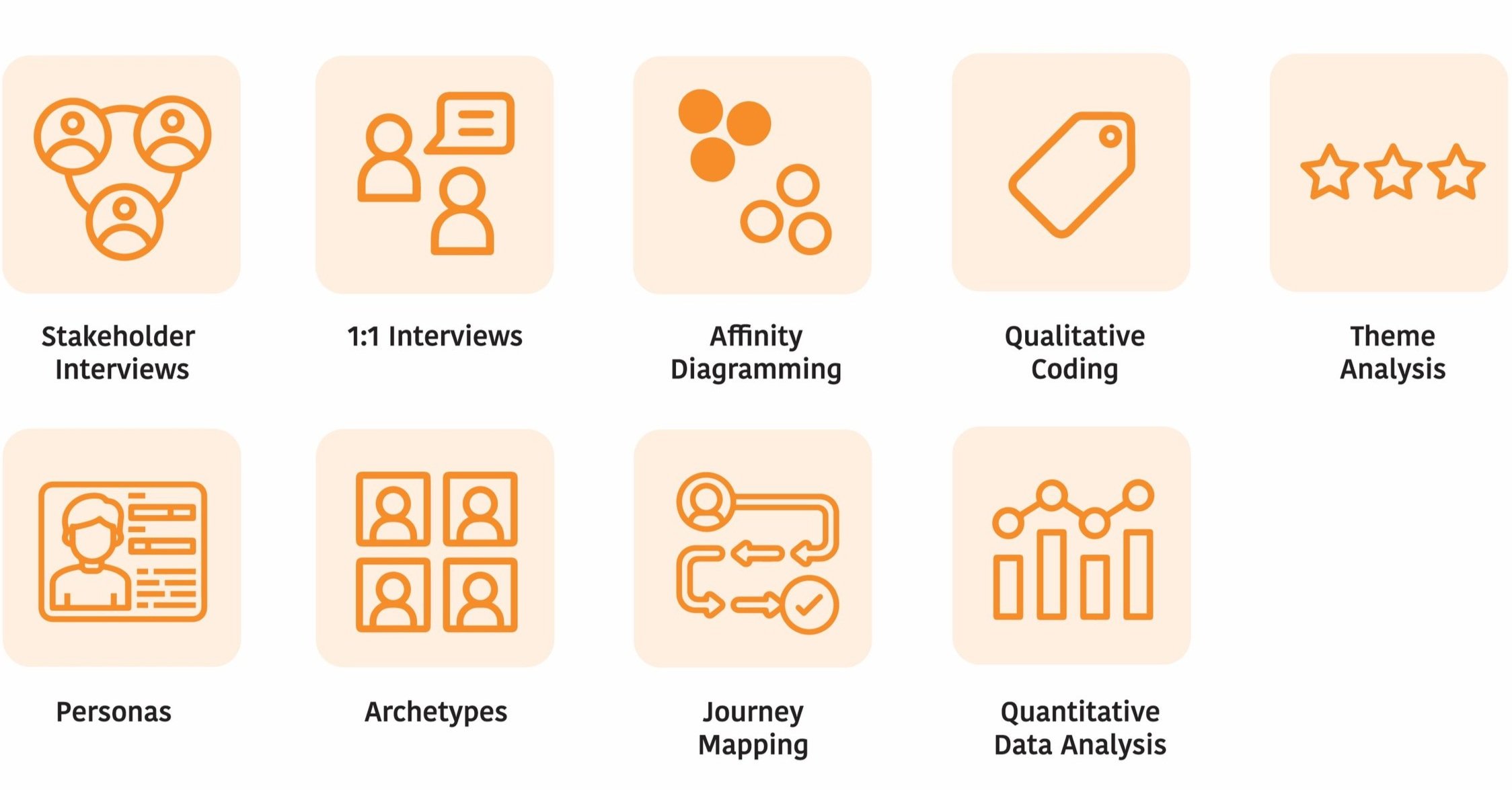
Tools: UserInterviews.com, Qualtrics, Miro, Trello, Confluence, Jira, BlueJeans, Teams, Adobe InDesign
Project constraints:
Very limited budget for participant compensation
All interviews conducted remotely due to COVID
Tight turnaround for project completion while concurrently working on research projects in other parts of the business [5 weeks]
PROJECT PLANNING
TIMELINE
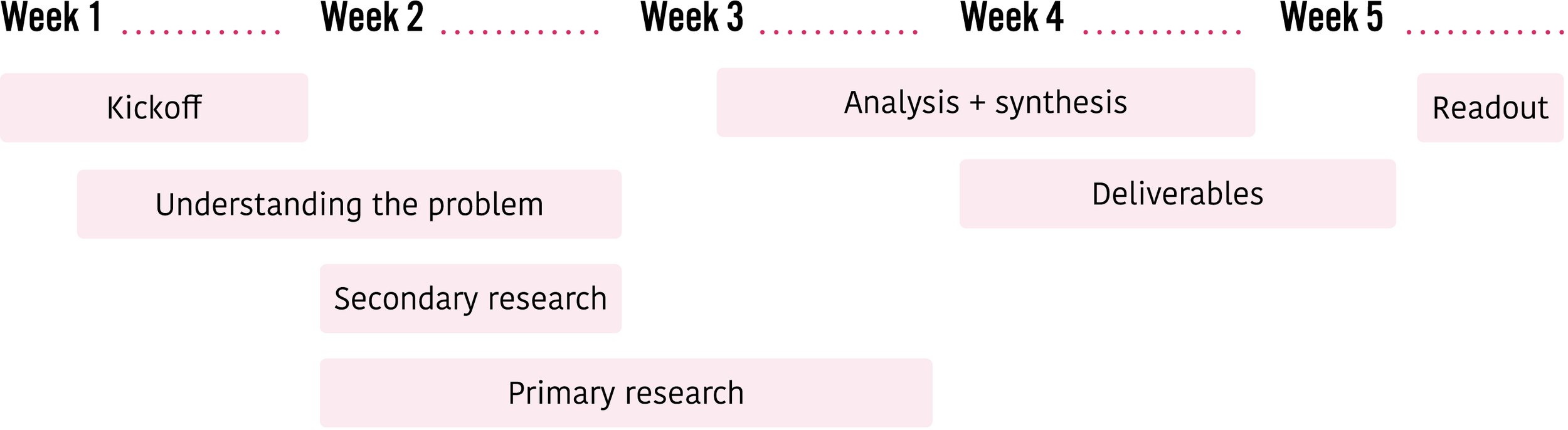
MY PROCESS*
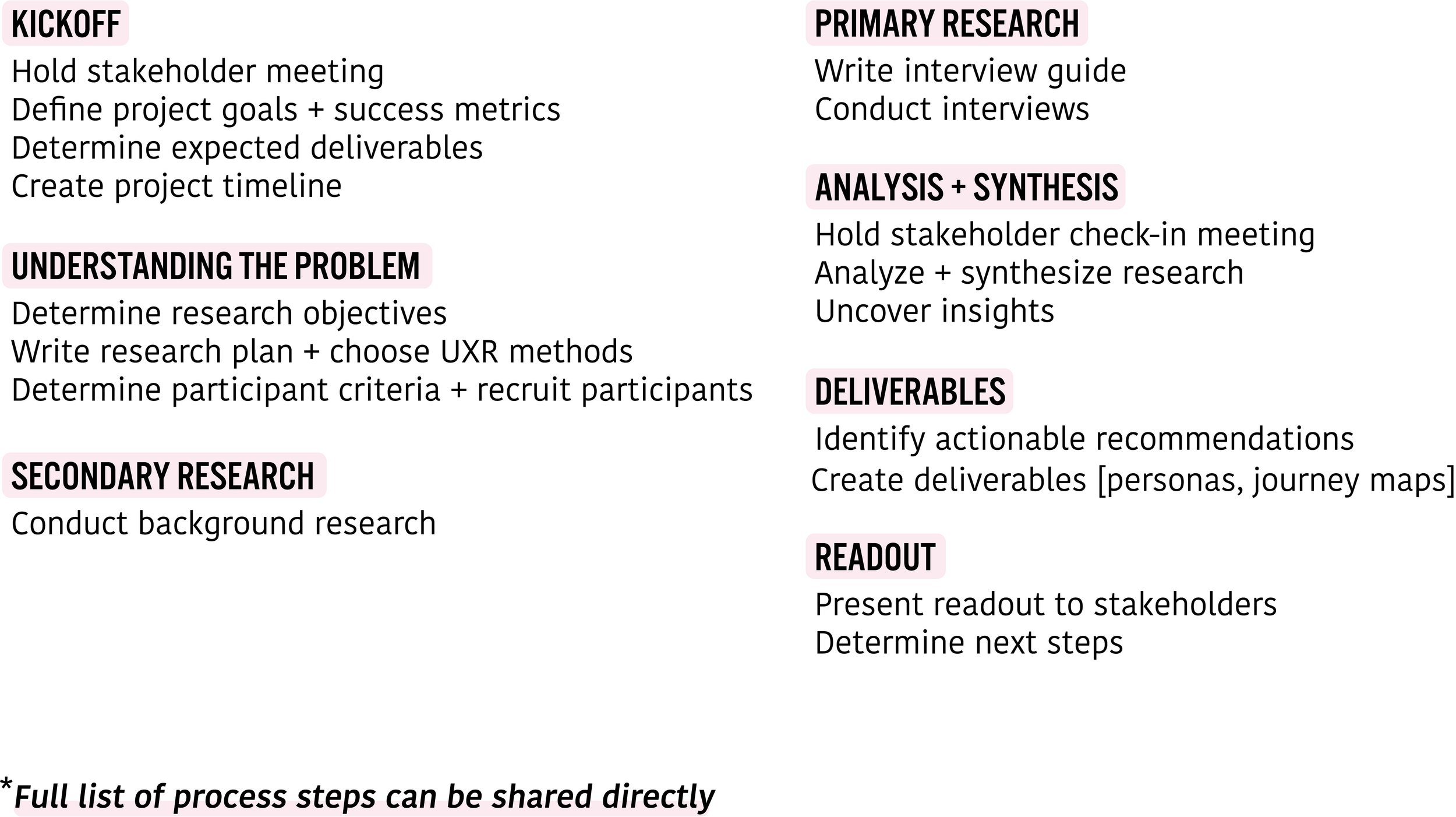
UNDERSTANDING
THE PROBLEM
THE CLIENT’S IDEAS
The client approached CoverMyMeds with a hypothesized reason for Songbird’s low submission rate and a suggested solution.
The client’s hypotheses:
Part 1 of the PA renewal takes too long for providers to complete
Providers have to wait too long to get back Part 2 of the PA renewal
The client’s proposed solution:
Allow providers to start on Part 2 of the PA (Part 1 would be auto-filled), which would reduce the number of steps in the process and save providers time, thus increasing the submission rate.
PROJECT GOALS & REFINEMENT
1
The original ask was twofold:
Determine why the client’s submission rate was lower than average
Validate the client’s hypotheses and proposed solution
2
However, I felt there was more to be learned by taking a step back and expanding the scope to include understanding the context in which providers use Songbird, as well as the entire PA renewal process. The project timeline was not affected.

ALIGNMENT & HIGH-LEVEL RESEARCH QUESTIONS
After leading a project kickoff meeting with the internal product team (2) to ensure alignment on the timeline and updated goals, I set out to uncover the reasons behind the client’s low submission rate by researching these high-level questions:
1 What factors affect submission rate?
2 What are the pain points providers face with expiring PAs and Songbird?
3 Would the client’s hypothesized solution be effective in increasing their submission rate?
UX RESEARCH
SEMI-STRUCTURED
QUALITATIVE INTERVIEWS
I chose hourlong 1:1 moderated interviews as the UXR method because I wanted to understand the why behind the users’ behavior and the 34% submission rate. Semi-structured was ideal to ensure that each interview included all major topics while also leaving room for deeper exploration of divergent findings.
I recruited and remotely interviewed 8 providers, focusing on users who were active within the past month, received the most Songbird alerts (top 20%), and had average submission rates less than 25%. I chose these users because they were experienced with the product and, if we could increase their submission rates, would present the biggest opportunity for impact.
SAMPLE INTERVIEW QUESTIONS
1 Walk me through the steps you take when an expired PA needs to be renewed.
2 Tell me about your most recent less-than-perfect experience with Songbird. What happened?
3 If Songbird changed to the client’s idea, what benefits, if any, would you get from these changes?
What new problems could it cause?
ANALYSIS & SYNTHESIS
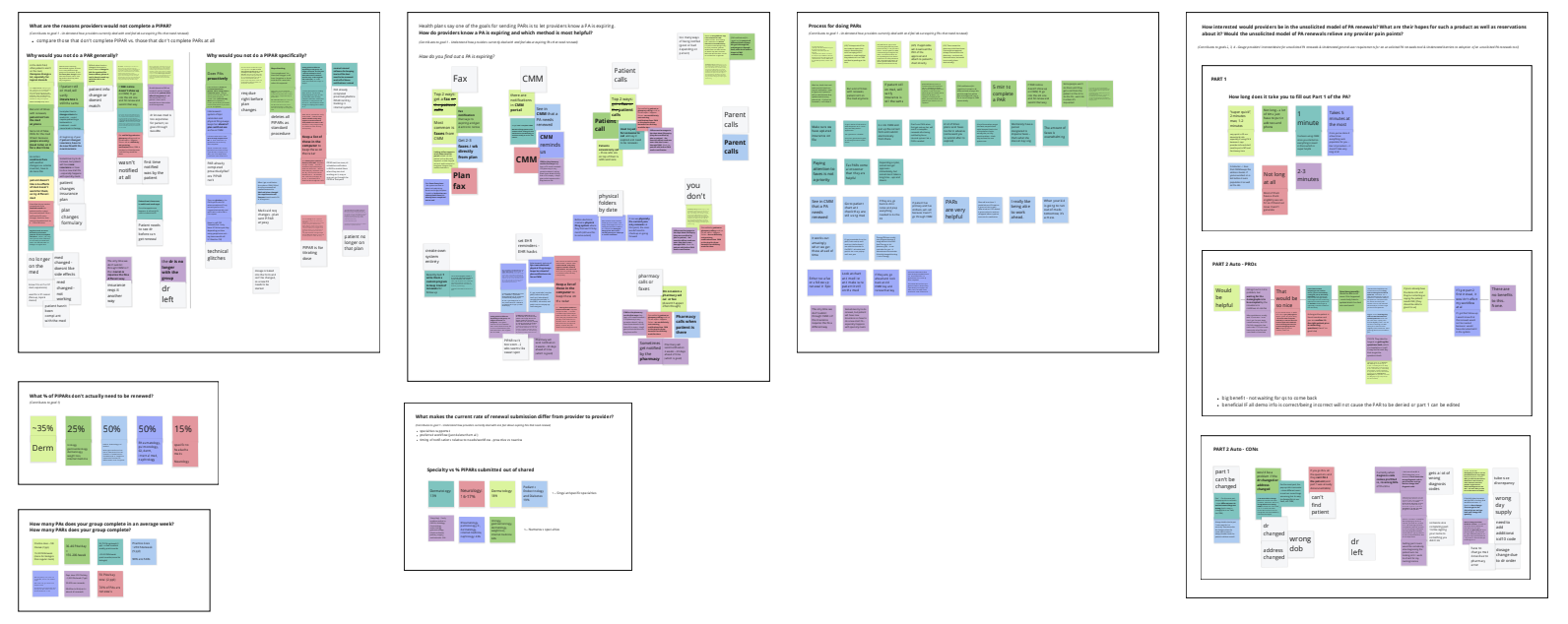
Using Miro to analyze and synthesize the data, I was able to qualitatively code the findings, produce affinity maps and uncover trends, leading to key insights and areas of opportunity.
(Intentionally blurry for NDA)
FINDINGS + ARTIFACTS
KEY INSIGHT 1
1
Users varied in their response times to Songbird alerts.
The timeliness of a user’s response to Songbird alerts greatly influenced submission rates. This timeliness could be viewed on a spectrum from reactive to proactive. Differences in reactivity were due to work style factors such as: the value placed on PAs compared to other duties like patient care, the point in the PA process when alerts were received, and past experience with the validity of Songbird alerts.
ARCHETYPES
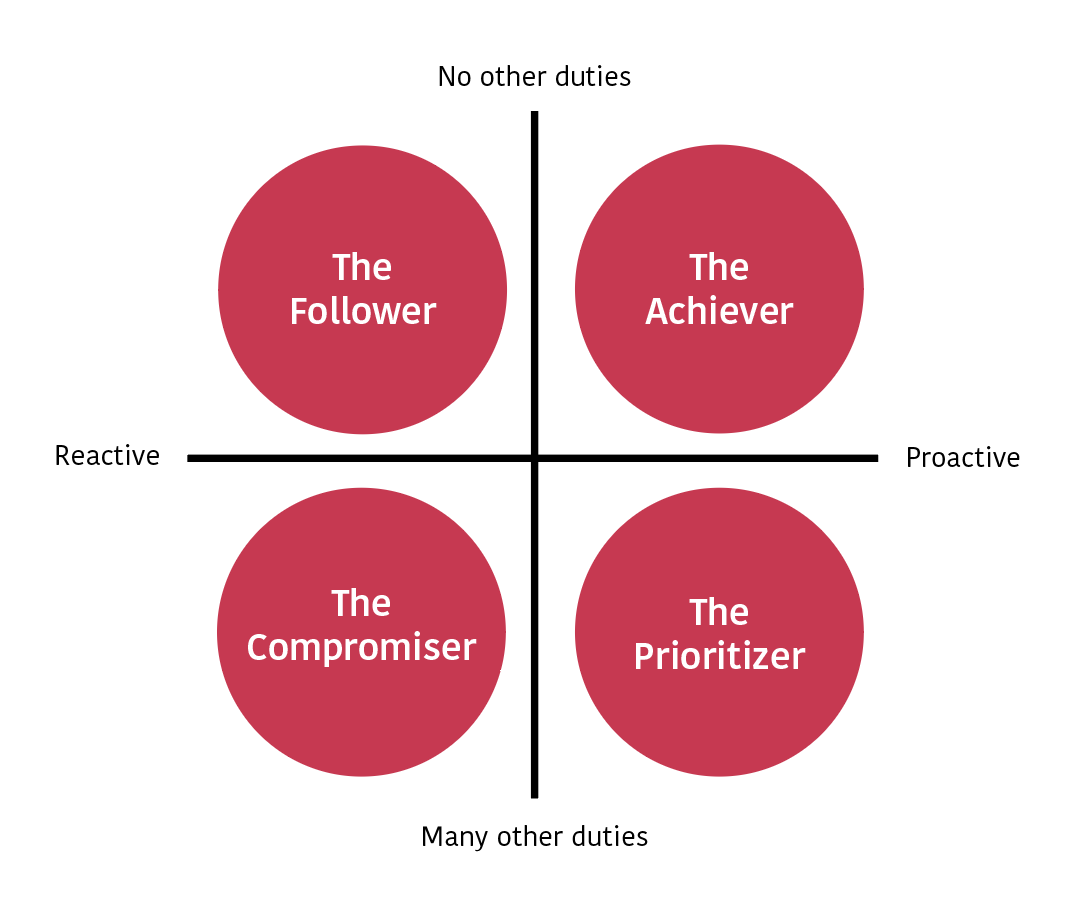
By analyzing work style (reactive vs. proactive) alongside situational context (the user only works on PAs vs. the user has many other duties), I was able to identify 4 distinct behavior-based archetypes:
The Achiever, The Prioritizer, The Compromiser & The Follower
(x-axis: work style / y-axis: situational context)
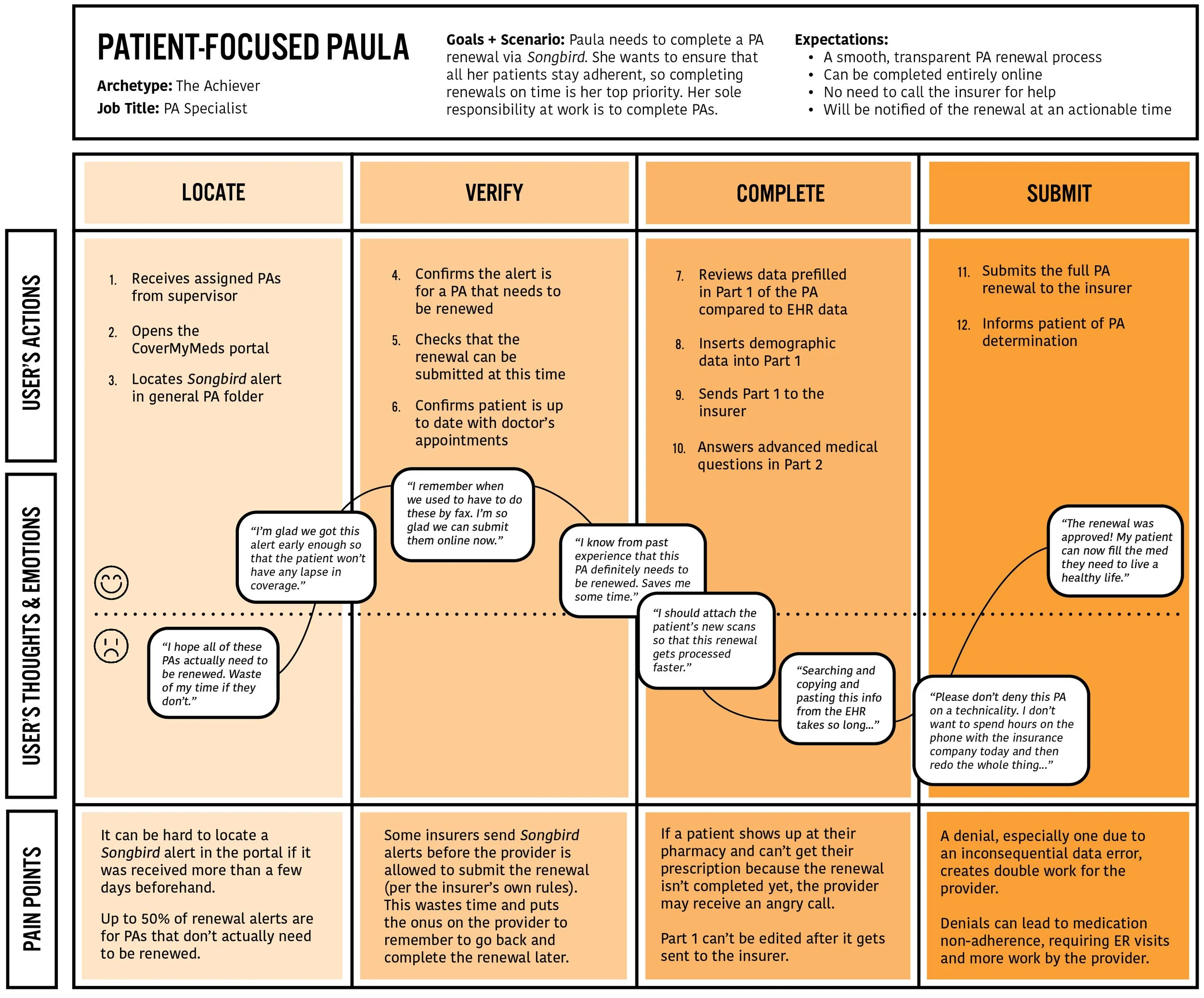
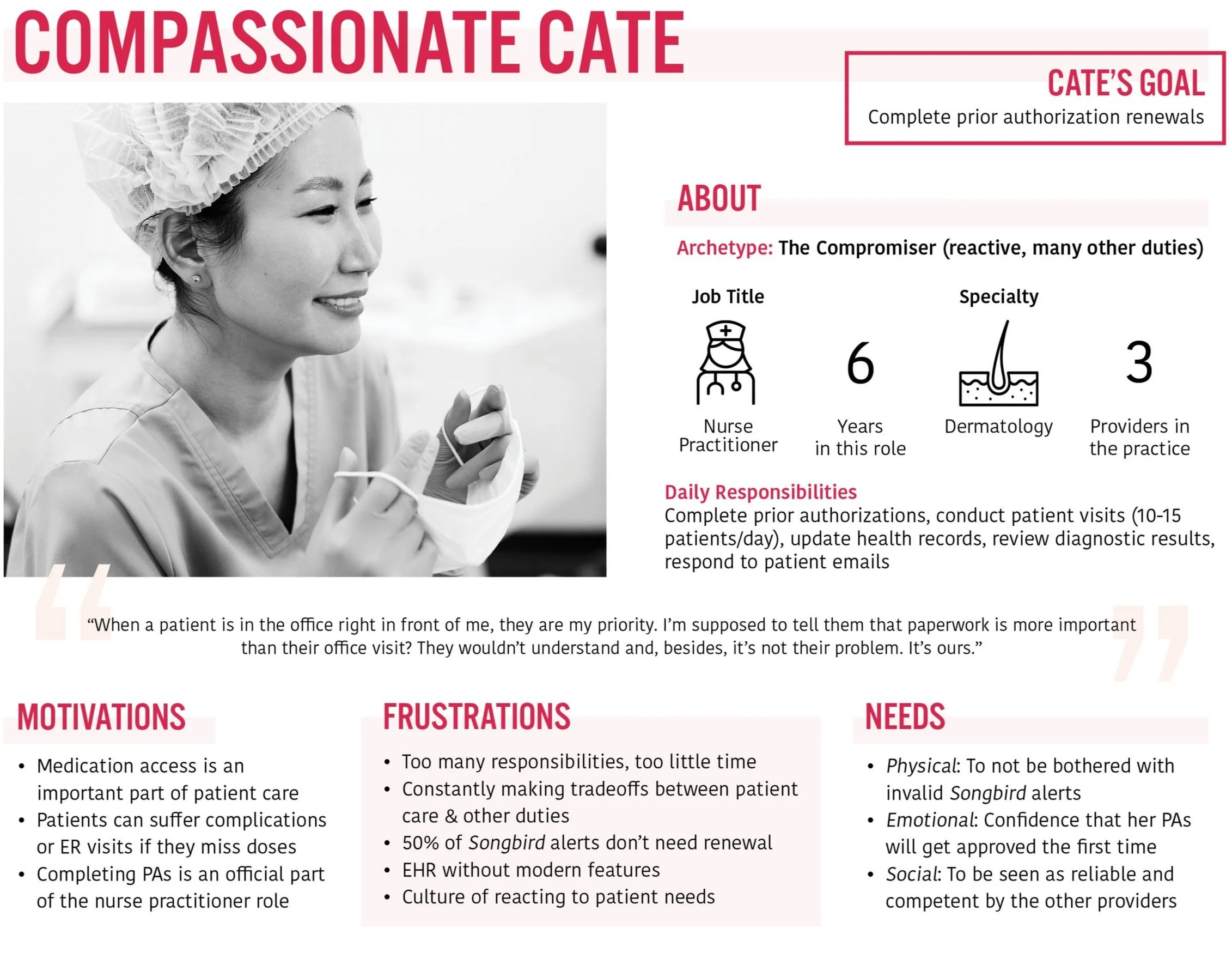
To help the client and product team build empathy for the users, I created a journey map for The Achiever and a goal-based/behavioral persona for The Compromiser. These artifacts show how users interact with Songbird as well as the context in which they work, illustrating the impacts of the users’ environment.
USER JOURNEY MAP:
THE ACHIEVER
PERSONA:
THE COMPROMISER
KEY INSIGHTS 2, 3 & 4
2
Up to 50% of alerts were invalid.
The client was sending many Songbird alerts for PAs that didn’t actually need to be renewed, such as for acute dermatological issues. Conversely, they were not sending alerts for other PAs that had a high likelihood of needing renewal. The client’s internal criteria for Songbird alerts was unoptimized.
3
Part 1 is quick to complete & needs to be 100% correct, 100% of the time.
Part 1 only takes 1-2 minutes to complete and can’t be edited once submitted to the insurer. If any information in Part 1 is incorrect (such as a patient’s apartment number), the PA will automatically be denied, making the provider fill out the entire PA again (30 min - 2 hrs). Part 1 information needs to be 100% accurate. Providers do not want the insurer to auto-fill this information due to it’s importance, their lack of confidence in the insurer’s internal data, and accountability concerns.

When I uncovered this insight, I took the initiative to expand the scope of the research to include quantitative data analysis. I hypothesized that the client was actually getting a higher % of renewals, but they were only looking at one metric that didn’t tell the whole story. By analyzing multiple pieces of data, I confirmed that the client’s renewal rate was actually 33% higher than they originally thought.
[Not filling out Part 1 myself] would be like me signing my name to a note that you took on a patient’s care. It would be somebody else diagnosing the patient without me looking at them. There’s no justification in my mind that I’d like you guys to do that. - Nurse LPN
The CoverMyMeds portal put Songbird alerts for PA renewals into the same queue as new PAs. This made it hard for the user to find the alerts if they did not immediately act on them, which was common. As a workaround, some providers resorted to creating entirely new PAs when a renewal was needed - a practice that the client disliked.
4
The CoverMyMeds portal made it easy to lose track of Songbird alerts.
ACTIONABLE RECOMMENDATIONS
1
Users varied in their response times to Songbird alerts, so…
Treat users as individuals by
meeting them where they are.
In order to send Songbird alerts when they are most actionable to different users, the client could work with CoverMyMeds to run additional data analysis and segment users by the 4 archetypes. Each archetype would have its own notification strategy to optimize users’ response times.
2
Up to 50% of alerts were invalid, so…
Update the criteria for sending
Songbird alerts.
CoverMyMeds could consult with the client on the PA criteria that trigger Songbird alerts in order to stop sending alerts with a low likelihood of renewal and to start sending more alerts with a higher likelihood of renewal. Updated criteria included: provider specialty, medication prescribed, and tried & failed medication list.
3
Part 1 is quick to complete & needs to be 100% correct, 100% of the time, so…
Don’t combine Parts 1 & 2 unless you can ensure accuracy.
Since providers do not want Part 1 auto-filled, the client should either discard their proposed idea or:
Present Parts 1 and 2 concurrently
or
Make Part 1 editable throughout the entire PA process
Don’t require that Part 1 be 100% accurate for certain data points that are likely to change over time
4
The CoverMyMeds portal made it easy to lose track of Songbird alerts, so…
Make Songbird alerts more
identifiable in the portal.
I collaborated with UX designers about ways to use color and additional text to designate PA renewals in the portal as well as collecting renewals in their own folder so that when Songbird alerts were received too soon to be actionable, providers could easily find them later.
REVISITING THE CLIENT’S PROPOSAL
Based on the research, both of the client’s hypotheses were disproven and the client’s proposed solution was rejected as it could have led to even lower submission rates due to incorrect information baked into the PA, as well as increased user aggravation.
OUTCOMES + IMPACT
1
The client wins
because they know their submission rate is actually higher than 34%, they now have data-backed action items to increase their submission rate even more, and they saved money by not building a solution that would have made the situation worse.
A WIN-WIN-WIN OUTCOME
2
The users win
because they will receive fewer unnecessary Songbird alerts and will have a better user experience in the CoverMyMeds portal.
3
CoverMyMeds wins
because the client is now exploring increasing their business 6x. Also, CoverMyMeds can use these findings to improve other clients’ submission rates and as a talking point with prospective clients.
+ BONUS WIN
The patients win
because making the prior authorization experience quicker and easier for users helps patients stay adherent to the medications they need to live healthy lives.
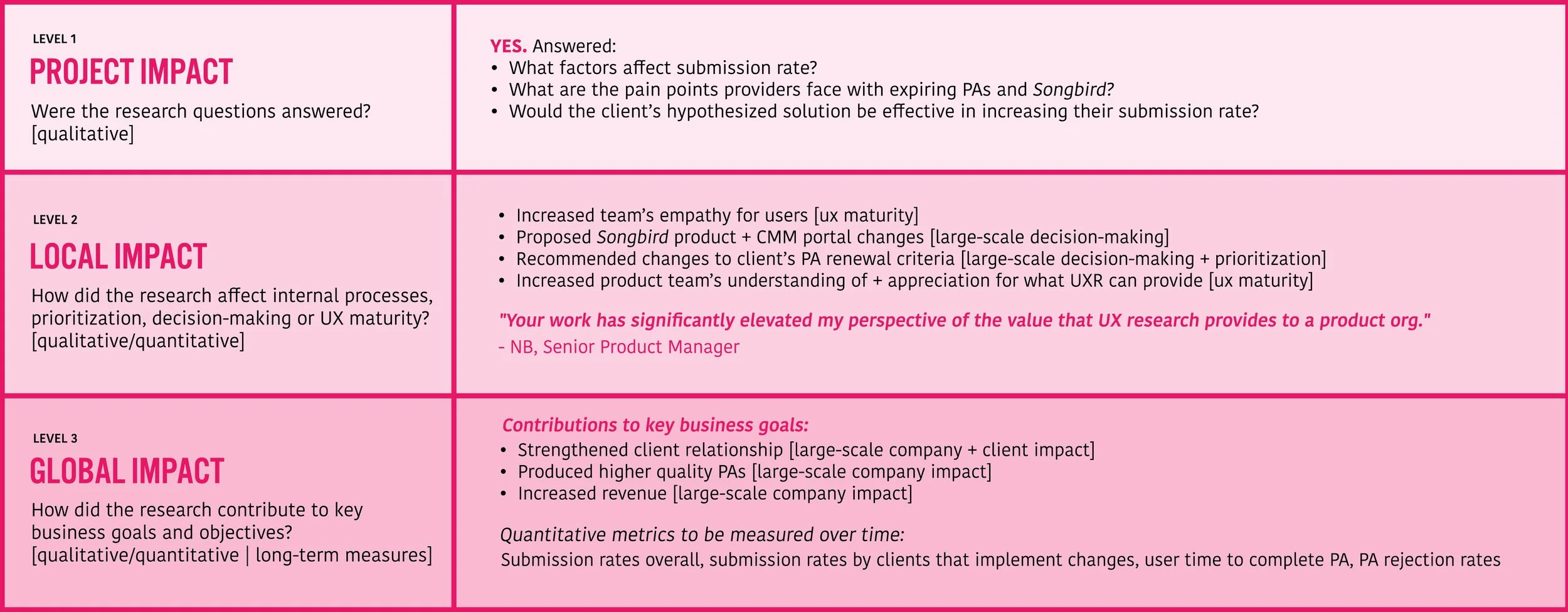
IMPACT
FINAL THOUGHTS
If I could continue this project, I would:
1
Interview additional user groups
Expand user criteria to include providers who receive fewer Songbird notifications but have higher submission rates to understand the differences in their experience from providers with lower submission rates
2
Explore other clients’ data
Dive into other clients’ submission rate data to look for additional best practices when sending Songbird alerts
3
Lead co-creation sessions
Plan and run co-creation sessions with the client to find solutions that act on the recommendations and are technologically feasible